Sunday, April 14, 2013

Recruits XXI F&IW After Action Report


As promised in an earlier post, here's the After Action Report from the third Blunder at Turtle Creek game I hosted at Recruits last weekend. The game was played with the ruleset This Very Ground. Details regarding  miniatures, scale and terrain can be found in this earlier post: A Frontier on Fire. The maps provided show the terrain as laid out using 12" square tiles. We used the rules as written; scale is one pace equals 1.5" so musket range at 15 paces is nearly two tiles long, rifle range is just over 3 tiles long and March movement is 3/4 of a tile. 

The scenario: "Following Braddock’s defeat on the Monongahela, the Pennsylvania frontier was awash in fire and blood. The French encouraged their Indian allies to raid the farms of the British colonists. As the infiltration of Lakes Indians and Coeur De Bois in French service increased, hostilities escalated. In response, many small excursions of British regulars and their colonial militia counterparts attempted to attack the Indians on their own terms. A nearly-abandoned storehouse on the very fringe of British settlement becomes the scene of the Blunder at Turtle Creek as one of these British counter-raids runs headlong into their intended prey."

The game was a meeting engagement between the British and Colonials, and the French and their Indian allies. The British started with a Unit of 5 Colonial Militia (settlers, actually) in the fortified storehouse, plus three Units of 5 Rangers, A Provincial Unit of 10 soldiers, two Units of 10 Regulars and a Unit of 10 Grenadiers. The French had two Units of 10 Marines (played as Light Infantry), 2 Units of 6 Coureur Du Bois, and 4 Units of 10 Indians. Each army had two additional Officers, the British with one mounted. The Militia in the storehouse were responsible for the wagon of supplies, the wagon being worth an additional 5 victory points to whichever side exited the road with it. Otherwise, the victory would be awarded on the basis of casulties inflicted.

The following photos show the table laid out per the map above, starting from the view from the south and going clockwise around the compass.


On Turn ONE, both armies alternated placing their Units on the table in accordance with the Initiative and Activation rules. The French point of deployment was the Northwest corner of the map, the British the Southeast. The Rangers and Coureur Du Bois were allowed to be placed anywhere on the table within 4 tiles of their respective corners, no closer than 12 paces of an enemy Unit. The remaining Units were to be deployed on the table edges within 4 tiles of their corners, with a normal Activation subsequent to deployment.

Here is the deployment at the end of Turn ONE.


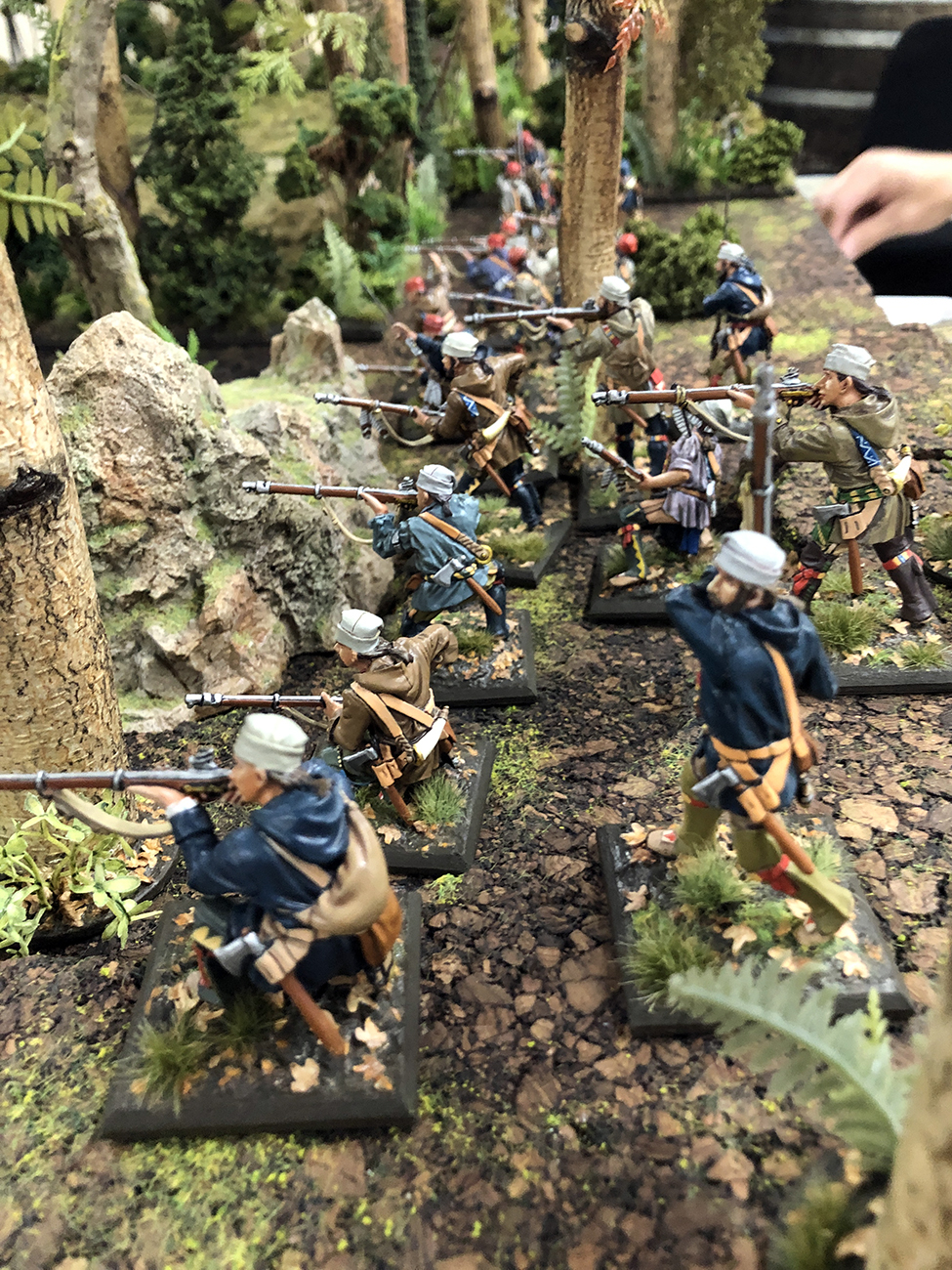
One Unit of Rangers was added to the Militia in the storehouse. The remaining Rangers and Coureur Du Bois (all armed with rifles) were set up at the edges of the woods to provide covering fire. Both commanders saw the open fields (Incidental Cover) around the storehouse as the key ground for their Regulars and deployed accordingly. The British chose to divide their Regulars by deploying one Unit in the woods on the south edge to cover the road, the French covering them with a Unit of Indians to keep them honest. 

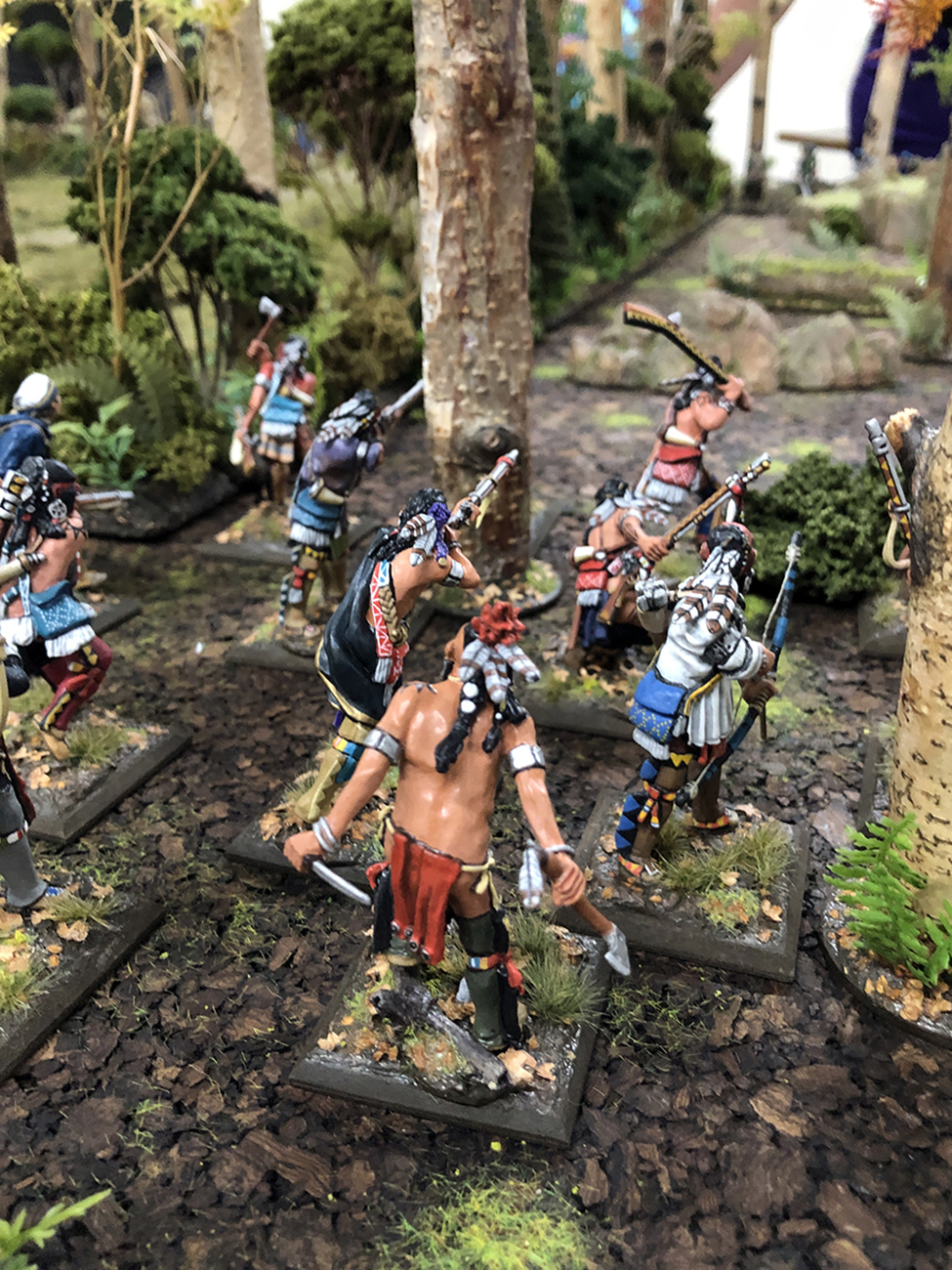
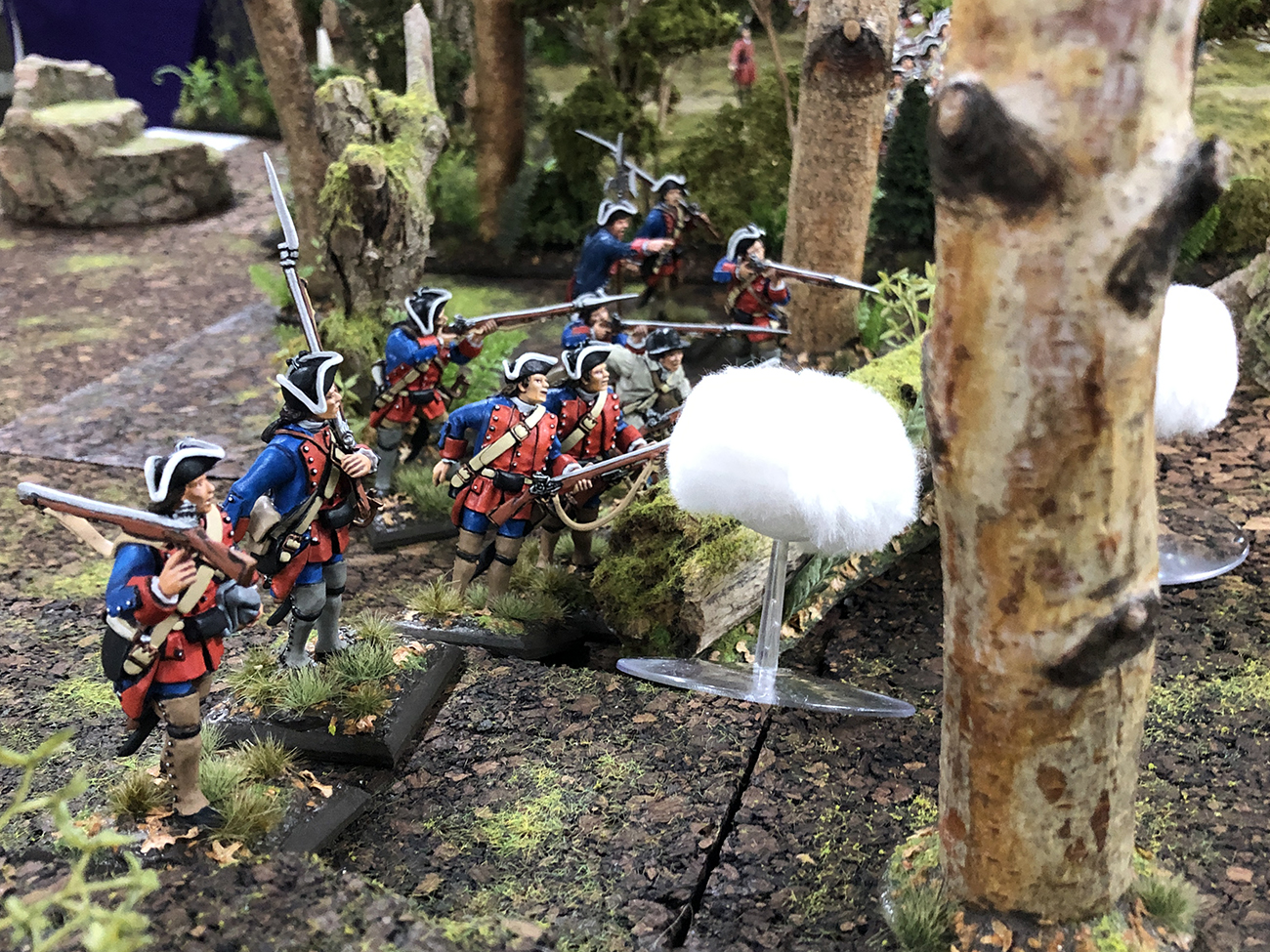
The Rangers provide covering Opportunity Fire as the French Marines and Indians move onto the table. You can see the red Disruption marker the Indian Unit earned by failing a Courage test after taking a casualty from the rifle fire. The brown bead is used to mark Units that have Activated that turn (and will forever now be known as "Milk Duds").


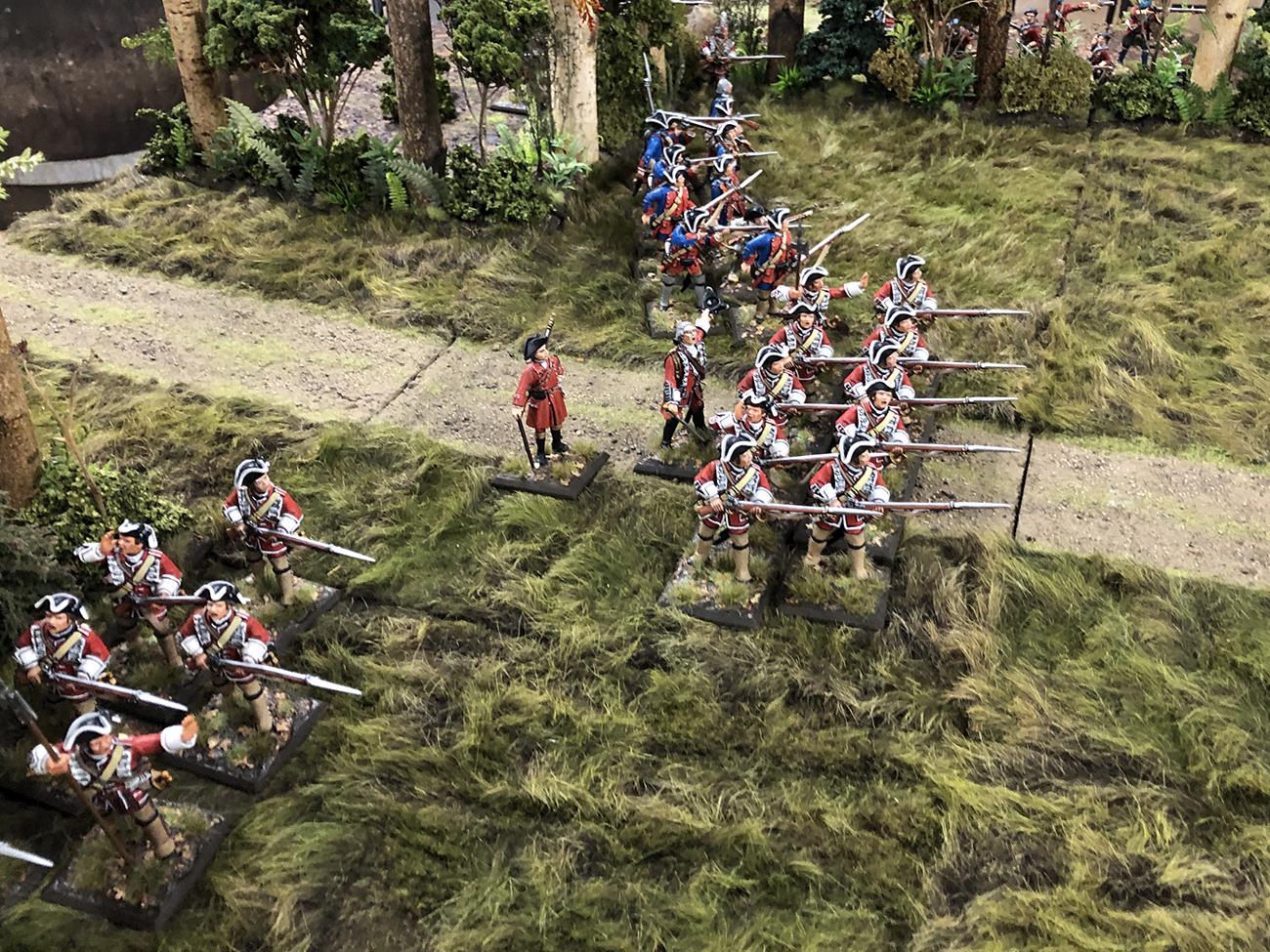
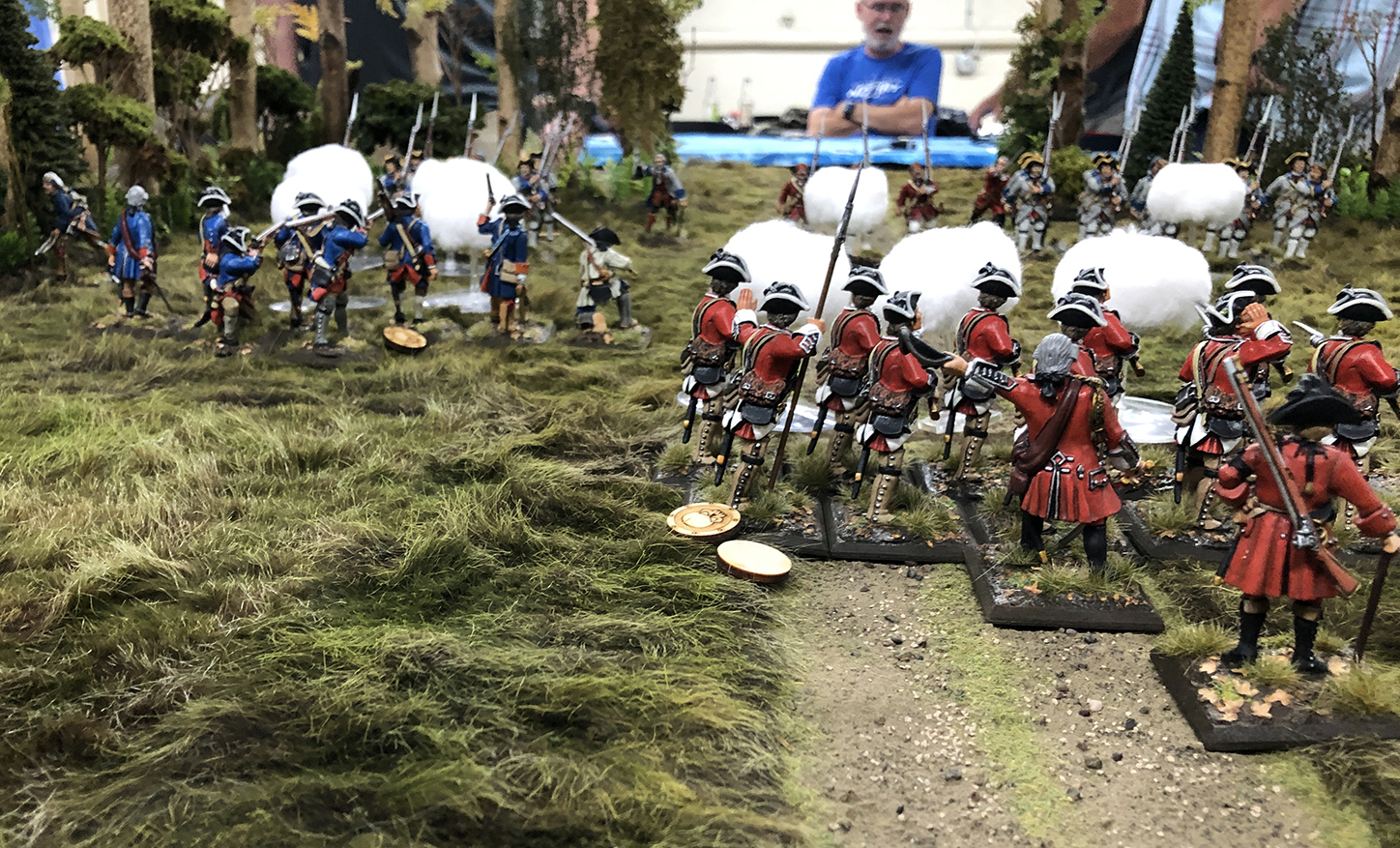
 On Turn TWO the Regulars of both sides moved into musket range, hazarding the covering fire, and released a full Volley at each other. The Britsh Grenadiers' volley was a complete whiff, rolling 10 dice without scoring a Wound! The French Marine Volley in response was withering, reducing the Grenadiers to less than half their original size, prompting a Courage check that they failed, rolling the only number that would fail, a "10" on a D10. 

The Indians surged forward through the Opportunity and covering fire providing their own skirmish fire as they advanced.


On Turn THREE the Grenadiers were auto-rallied by the mounted British Officer and pulled back, allowing the Regulars and Provincials to fire Volleys at the French Marines. The lead Marine Unit was decimated by the Volleys, and so the French advanced their rearmost Marine Unit through the crippled lead Unit, and it answered with its own Volley. The British Regulars on the south edge decided to cross into the open onto the road, and were met with Opportunity and skirmish fire from the Coureur in the woods across the road.


On Turn FOUR, with all of the Regulars around the storehouse at 4 Volume of Fire points, and reloading, the Indians were goaded into Charging the British Regular Unit. Judicial placement of the French Officers, as well as impressive rolls during previous Courage tests, had kept the Indians closing range each turn, despite the casualties and Disruptions caused by the fire from the Rangers and the Militia. The Melee was hard fought, but the Indians' winning of Initiative and their higher Valor characteristic was too much for the Regular Unit, which was killed to the last man (as are all the losers of Melees in This Very Ground). The British Regulars on the road then marched up to the treeline and loosed a Volley into the Indians in the woods, but the Cover provided the Indians by the woods made it virtually ineffective.


On Turn FIVE, the largest Indian Unit outside the storehouse Charged the Provincials, which ended much like the preceding Melee with the Regulars. The Indians in the woods on the southern edge likewise charged their Regular opponent, and with the Initiative won and a brutal set of dice rolls in the first round of Melee, quickly eliminated the British Unit. Here are the winners of the three Melees.


Note the Disruption markers as the Indians outside the storehouse, too far from their Officers to benefit from their Courage characteristics, and having taken many casualties, failed their after-melee Courage tests. Busy with scalps, perhaps. . .

So the situation at the end of Turn FIVE: 


At this point the British ceded defeat, noting that with no Regular forces left (the Grenadiers would soon be overwhelmed) they could have little impact on the ground outside the storehouse. From a "total casualty" standpoint, the French were indeed ahead, but not substantially so. The loss of 3 entire British Units, compared to no French Unit losses, was the difference.


None of the players had any experience with This Very Ground before; my instructions were to "play the appropriate tactics" instead of the rules, where there was any doubt, and all the players were impressed with how the rules captured the feel of the historical period. I noted we did one thing wrong, in that we allowed Units to Volley the same turn they Marched, but as we were consistent the entire game I don't think it had a major unbalancing impact. The Indians were the stars of the game, and the French players' decision to mass them around the stockade, coupled with the British players' deployment of the lone Regular Unit on the southern edge, led to the French victory.

Another fun Recruits. Here are some additional photos from the second game we played.


 See Ya!


Wednesday, April 10, 2013

A Little Taste of Recruits


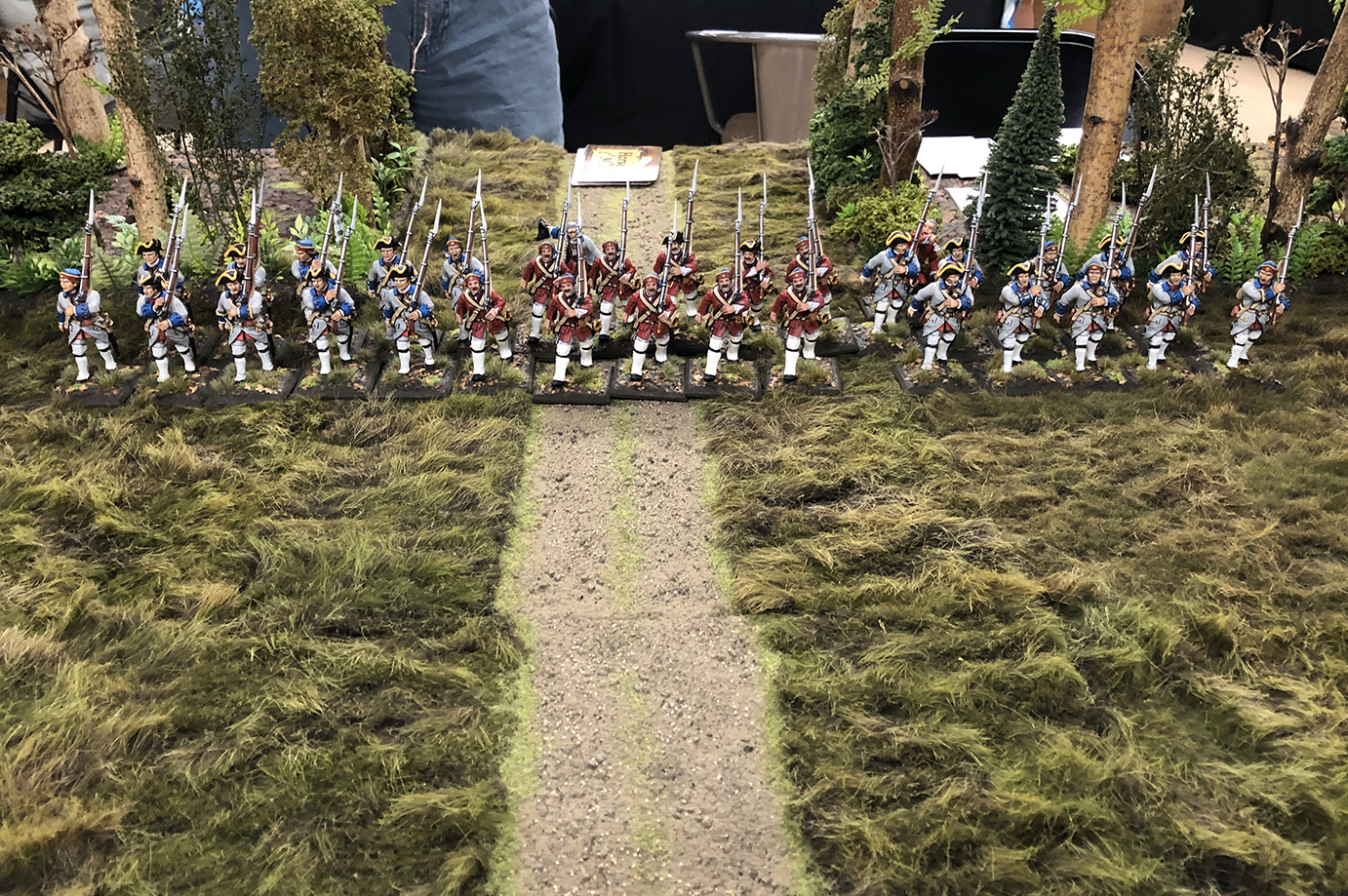
Recruits has come and gone again. Here are a few photos of the first of three French and Indian War games I presented, featuring John Jenkins figures and played with This Very Ground. I plan to do a proper AAR later this week. Enjoy.


See ya!

Friday, March 29, 2013

Terrain Two Point Oh Yeah!


Here's a shot of the terrain upgrade in progress deep in the donjon at Chateau d' Amok, to prove to The Baron that I'm "gettin' to it."

This upgrade takes us from Terrain One Point Oh My. . .


 to Terrain Two Point Oh Yeah!


In addition, the good folk at Renaissance Ink hooked me up with some thin profile, beveled masonite bases, complete with magnetic bottoms, for my Jenkins figures. The masonite has a great "woodsy" color feel that works really well with the terrain. Now all my "little guys" stand tall -  even in the Rough.

Come see us at Recruits!

Friday, March 15, 2013

Recruits Is Coming!


I committed today to presenting "Blunder at Turtle Creek" at Recruits in April. "Blunder" will be fought using This Very Ground, of course. I am using the Blood in the Forest scenario from the rulebook but adding a "civilian" twist, and using points to provide  balanced forces.

The  introduction:

"Following Braddock’s defeat on the Monongahela, the Pennsylvania frontier was awash in fire and blood. The French encouraged their Indian allies to raid the farms of the British colonists. As the infiltration of Lakes Indians and Coeur De Bois in French service increased, hostilities escalated. In response, many small excursions of British regulars and their colonial militia counterparts attempted to attack the Indians on their own terms. A nearly-abandoned storehouse on the very fringe of British settlement becomes the scene of the Blunder at Turtle Creek as one of these British counter-raids runs headlong into their intended prey."

I have some terrain work to do over the next couple of weeks. . . I may show some of it in progress if I have time.

See ya!


Tuesday, March 12, 2013

Got my Studio Tomahawk on! Part Two.


And the winner is. . .


This Very Ground from Iron Ivan Games. What the . . . !?

If you've visited here before, you may be aware that I was already invested in This Very Ground for my French and Indian War project when I decided to give Muskets & Tomahawks a look. Overall, Muskets & Tomahawks is a very nice product. The N.C. Wyeth illustration on the cover alone gets a nod. 

Recently The Baron pointed me to a post on Anatoli's Game Room that includes a thorough review of Muskets and Tomahawks as well as a "short comparison" with This Very Ground that I find quite useful. If you're interested, Mr. Anatoli also provides a similarly-thorough review of This Very Ground here (and I do hope Mr. Anatoli doesn't mind the links, but I would be hard-pressed to improve on his detailed reviews).

So why do I use the term "useful" to describe the comparison? The comparison provides an opportunity to show subjectivity in practice, as Mr. Anatoli and I look at the same points of difference between the rulesets and draw opposite conclusions, based ultimately, I think, on "what we like." Both systems quite obviously provide a good game and lots of period flavor. . . but as we all know, it often just comes down to what "feels right." Mr. Anatoli  is calling Muskets & Tomahawks (M&T) his "go to" set of rules for the French and Indian War, while I have decided to stick with This Very Ground (TVG). For example, if we look at the comparison:

1) Shooting Mechanics. In M&T each soldier in a unit can take one action, which means some soldiers can move while others shoot while still others reload. Individual soldiers' firings have to be tracked for reloading, which I don't like as well as the Volume of Fire in TVG, which is tracked by unit, and provides a neat little morale mechanism based on the amount of firepower a unit puts out.

2) Movement Mechanics. I prefer that in TVG Regulars are limited to Formed Formation, regardless of terrain, which makes them slow and cumbersome in the forest, all the time. Regulars don't get to break into skirmish formation for movement in the woods, which I think better reflects their European training prior to their arrival in the colonies.

3) Close Combat. I really like the "psychology tests" involved in the "Charge" and "Standing Ground" procedures prior to Melee. Used with the Initiative system, there is real finesse in the tactics of driving off the enemy with a volley and the threat of the follow-up with cold steel. If you can get to hand-to-hand, the new streamlined procedure makes Melee fast and lethal.

4) Casualties/Morale. TVG uses a roll to hit and a roll to wound based on a D10, and different Volumes of Fire provide Morale modifiers - the "psychology" of coming under fire is well illustrated. Using a D10 (rather than the D6 in M&T) allows Units to be defined more through differences in numerical ratings as opposed to the use of "traits." Morale is based on percentages of casualties in a unit - this coupled with the D10 means the game is scalable. A unit can be 5 soldiers or 20 and the game plays just the same.

M&T uses a deck of cards to activate units; it works fine. I prefer the Initiative-based system of TVG because it is a little sneakier - you can actually choose a disrupted enemy unit to activate on your Initiative and force to it take a Rally test that just might cause it to rout off the field if it fails. . .

M&T's Scenario Generator and Random Events are great features. No reason you couldn't use them with TVG, too.

So two really good game systems. . . and which one is "better" is totally subjective. 

I'll be taking This Very Ground to Spring Recruits in April. See ya there, maybe!